Key takeaways
- Find the best room dividers for studios, bedrooms and open-plan homes, from folding bamboo screens to single fabric panels and woven partitions.
- Top Pick: Rose Home Fashion Bamboo Room Divider, 6 Panel
- Runner-up: Sorbus Room Divider, 8 Panel
- Also consider: MyGift 6-Panel Room Divider with Asian Water Village Print
Open-plan living looks great in photos and feels less great at 7 a.m., when one person is on a video call, another is trying to sleep, and the workout corner stares at the sofa. A room divider is the fastest way to carve a studio, shared bedroom, or open living area into zones without building or drilling anything. The right screen is a visual wall you can move, fold, and take with you.
The five dividers below cover the main styles worth buying: classic folding bamboo and wood screens, extra-wide woven partitions for long spans, a single fabric panel that works like a curtain on feet, and a printed screen that doubles as artwork. They differ in width, height, light filtering, and folded size, so match the pick to your gap and how often you will move it.
As an Amazon Associate, we earn from qualifying purchases.
Quick answer
For most homes, the Rose Home Fashion 6-panel bamboo screen is the safest buy: it folds into straight, L-shaped, or zigzag layouts and stores flat. The Sorbus 8-panel covers the widest span, the RANTILA single panel suits renters who move often, the MyGift adds printed artwork, and the Duraspace woven screen filters light softly.
The best room dividers
Rose Home Fashion Bamboo Room Divider, 6 Panel

This is the traditional folding screen done well: six bamboo panels in a wood frame, joined by double hinges. Set it straight across a studio to hide the bed, angle it into an L around a desk, or zigzag it for stability on hard floors. At about 5.6 feet tall it blocks sight lines for seated and standing adults, and the tight bamboo weave looks warm and natural rather than office-like.
Storage is simple: it collapses to one panel wide and slides behind a sofa or into a closet, and it arrives ready to stand. Stretched fully flat it is less stable than with a gentle fold, so leave a bend in it.
Specs:
– Panels: 6 folding panels
– Overall size: about 96 inches wide by 67 inches tall (5.6 feet)
– Panel width: about 16 inches each
– Material: woven bamboo with a wood frame
– Hinges: double-action, fold both directions
– Assembly: none required
– Storage: folds flat to a single panel width
Best for: studio apartments and living rooms that need a classic, flexible folding screen.
Sorbus Room Divider, 8 Panel

When the gap is wide, panel count matters, and the Sorbus brings eight of them. Fully opened it spans about 130 inches, enough to cross a large living room, section off a guest bed, or back a home office desk. Its poplar wood frame and woven polypropylene strips keep it light for its size while holding their shape.
Double hinges let each panel swing either way: run it straight with a slight accordion fold for balance, curve it gently, or fold back the ends into a three-sided nook. The weave is semi-private: it blocks direct views and softens light rather than sealing a space off, suiting shared rooms where you want separation without darkness. It needs no assembly and folds down to a single stack against a wall.
Specs:
– Panels: 8 folding panels
– Overall size: about 130 inches wide by 72 inches tall (6 feet)
– Material: poplar wood frame with woven polypropylene strips
– Hinges: double-hinged, flexible configurations
– Assembly: none required
– Colors: gray, beige, black, and other neutrals
– Storage: folds into one stacked panel bundle
Best for: wide openings, large living rooms, and anyone who needs maximum coverage from one screen.
RANTILA Single Large Panel Room Divider
The RANTILA takes the opposite approach: one single fabric panel, about 71 inches wide and 71 inches tall, stretched on a steel frame with flat feet. With no zigzag to arrange and no hinges, it reads as a clean, flat visual wall, closer to a curtain divider than a traditional screen. At under nine pounds it is the easiest divider here to carry between rooms or into storage.
The UV-protected, waterproof HDPE fabric makes this the pick for spots other screens dislike: beside a patio door, in a bright sunroom, or anywhere splashes and humidity are part of daily life, and it wipes or rinses clean. The trade-off is shape: a single flat panel cannot wrap a corner or stand in an L, and it needs its feet fully extended on a level floor to feel steady.
Specs:
– Panels: 1 single panel
– Overall size: about 71 inches wide by 71 inches tall
– Material: HDPE fabric panel on a steel frame
– Weight: about 8.8 pounds
– Fabric: UV-protected and waterproof, wipes clean
– Base: flat feet, no wall or ceiling contact
– Assembly: frame assembly required
Best for: renters, frequent movers, and bright or damp rooms where a washable fabric panel makes sense.
MyGift 6-Panel Room Divider with Asian Water Village Print

Some dividers hide; this one decorates. The MyGift screen carries a dual-sided vintage Asian water village ink print across six woven bamboo panels, framed in black-finished solid pine. Because the artwork appears on both faces, it works mid-room where both sides show, as a desk backdrop, or as a statement piece that happens to divide a space. Opened flat it covers about 94.6 inches at 68.9 inches tall, so the separation is real, not just decorative.
Double swing metal hinges let it fold, angle, and store like any good screen, collapsing to a stack about 15.5 inches wide. The woven bamboo has texture and slight translucency up close, so the print never feels like a flat poster. Finishes can vary slightly, and the printed surface deserves gentle dusting rather than wet cleaning to protect the ink.
Specs:
– Panels: 6 folding panels
– Overall size: about 94.6 inches wide by 68.9 inches tall
– Panel width: about 15.5 inches each
– Frame: solid pine wood with a black finish
– Panels: woven bamboo strips with a dual-sided ink print
– Hinges: double swing metal hinges
– Folded size: about 15.5 by 4.7 by 68.9 inches
Best for: living rooms and bedrooms where the divider should double as wall art.
Duraspace 6 Panel Weave Fiber Room Divider
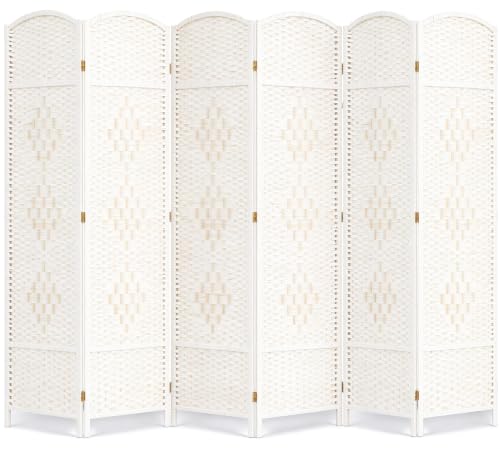
The Duraspace is the light-filtering option: six panels of woven plant fiber in a wood frame, about six feet tall and roughly 95.7 inches wide when opened. The weave has tiny gaps that let daylight pass while breaking up sight lines, so a divided room keeps its brightness. It suits splitting living from dining space, or screening a patio door, where a solid screen would leave one side gloomy.
Double hinges give the usual folding freedom: straight runs with a stabilizing zigzag, corner wraps, or a folded-back section to shorten the span. The woven fiber is light and easy to reposition, though it prefers indoor or sheltered use and gentle handling over being dragged across rough floors. It folds flat for storage and needs no assembly.
Specs:
– Panels: 6 folding panels
– Overall size: about 95.7 inches wide by 72 inches tall (6 feet)
– Material: woven plant fiber panels with a wood frame
– Hinges: double-hinged, fold in both directions
– Light: semi-private, filters daylight
– Assembly: none required
– Storage: folds flat
Best for: bright rooms where you want separation without losing natural light.
How to choose
Start with width, because panel count decides how much space you can divide. A single panel covers about six feet. Four to six panels span roughly eight feet once you add the stabilizing fold every freestanding screen needs, and eight panels reach around eleven feet. Buy one panel more than your raw measurement suggests: a screen pulled completely flat is at its widest but least stable, so plan for a gentle zigzag.
Height decides whether the privacy is real. Most home dividers stand between 5.6 and 6 feet, enough to block views of a bed, desk, or sofa area, but in a room with tall ceilings there will always be a gap above the screen, so treat a divider as a visual boundary, not a floor-to-ceiling wall. If you are tall or the screen guards a dressing area, favor the six-foot models; for a seated work nook, shorter screens are fine.
Material shapes both privacy and light. Solid wood and tightly woven bamboo block the most view and feel most substantial. Woven fiber and polypropylene weaves are semi-private: shapes blur, light filters through, and the room stays bright. Fabric panels like the RANTILA sit in between, blocking views fully while staying light and washable. Match material to the job: full screening for sleeping areas, light-filtering weaves for shared living spaces.
Stability comes from shape, not weight. A folding screen stands best with a shallow zigzag or an L at one end, flat feet fully opened on single panels, and a level floor; thick carpet can rock a screen that feels solid on wood. Check folded dimensions if storage is tight: every pick here folds to roughly one panel wide but needs a tall closet or under-bed clearance. Finally, all five picks are freestanding with no drilling, and a curtain on a tension rod is the other no-hole option when a screen’s footprint does not fit.
Who should skip
Skip a freestanding divider if you need sound privacy: screens block views, not noise, and a shared-room phone call will still carry. If you need a floor-to-ceiling division, a sealed door, or a barrier a determined toddler or large dog cannot push past, a lightweight screen is the wrong tool; look at bookcases or ceiling-fixed curtain tracks instead. Homes with very high ceilings may find six-foot screens visually lost, and the space-poor should measure the zigzag footprint, not just the span.
FAQ
How tall should a room divider be for real privacy?
Around six feet works for most adults, since it blocks standing and seated sight lines across a room. Shorter screens near 5.6 feet still hide a bed or desk well. No freestanding screen reaches the ceiling, so expect privacy for eyes, not a sealed room.
Can a room divider block noise?
No. Screens and fabric panels are visual barriers, and sound passes over and around them almost freely. A heavy fabric panel may soften echoes slightly, but for calls or sleeping you need distance or a door, not a divider.
Will a folding screen stand safely on carpet?
Usually, yes, if you give it a zigzag or L shape instead of running it flat, with modest fold angles. Deep pile carpet can make tall, light screens feel tippy; wider panel counts and woven wood models feel steadier.
What is the best divider option for renters?
Any freestanding screen works because nothing attaches to walls or ceilings. The RANTILA single panel is especially renter-friendly: light, washable, and quick to move out. A curtain on a tension rod is the other no-drill option when floor space is limited.
Final verdict
For a first divider that suits most rooms, choose the Rose Home Fashion 6-panel bamboo screen: flexible layouts, honest privacy, and flat storage. If your opening is wide, the Sorbus 8-panel is the coverage pick, while the RANTILA wins for renters and damp or sunny spots. The MyGift turns separation into decoration, and the Duraspace keeps a divided room bright. Measure your span, add a panel for the stabilizing fold, and any of these five will do the job.