Key takeaways
- Find the best bed pillows for side sleepers, from an adjustable U-shaped latex pillow to firm contour foam and a cooling grid pick for aligned sleep.
- Top Pick: Tempur-Pedic TEMPUR-Ergo Neck Pillow, Medium Profile
- Runner-up: EPABO Contour Memory Foam Pillow, Firm and Queen
- Also consider: Purple Harmony Pillow, Standard Medium
Side sleeping puts your head at the end of a long lever: the distance from your ear to the edge of your shoulder has to be filled by something, or your neck spends the night bent toward the mattress. A pillow that is too flat lets the head drop, and one that is too thick pushes it upward, so loft matters more for side sleepers than for anyone else. The goal is easy to picture: head and neck continuing the straight line of your spine.
The five pillows below approach that goal in different ways. One has a cutout that makes room for your shoulder, two are firm contour designs, one wraps a latex core in a flexible grid for airflow, and one is a gusseted down-alternative pillow for combination sleepers. None suits every build, so the notes on loft, fill and firmness matter as much as the pick itself.
As an Amazon Associate, we earn from qualifying purchases.
Quick answer
Side sleepers need loft that fills the gap between ear and shoulder without tilting the head. The Eli & Elm Side Sleeper Pillow is the most tailored option, with a shoulder cutout and adjustable fill. The TEMPUR-Ergo Neck Pillow suits firm contour support fans, the EPABO contour is the value pick, and the Purple Harmony is the cooling choice for hot sleepers.
The five picks in detail
Eli & Elm Side Sleeper Pillow
Most pillows are rectangles, but a rectangle is not shaped like the corner where neck meets shoulder. The Eli & Elm is curved into a shallow U, so the front edge dips down and leaves room for your shoulder to sit under the pillow instead of being pushed forward by it. For side sleepers who wake with a shoulder bunched toward their ear, that cutout is the point of the design.
The fill is a blend of shredded latex and polyester fiber in a zippered liner, and you can add or remove handfuls to set the height, which matters because correct loft depends on shoulder width and mattress firmness. The latex keeps the fill springy, and the cotton-blend cover breathes well. The trade-offs: the shape needs its matching shaped pillowcase to sit neatly, and at around six pounds it is heavy to move.
Specs:
– Fill: shredded Dunlop latex and polyester fiber blend
– Loft: adjustable, up to about 6 inches
– Size: Queen, about 17 x 29 inches
– Shape: U-shaped contour with a shoulder cutout
– Cover: cotton-blend, removable
Best for: Dedicated side sleepers who want to fine-tune pillow height and like the idea of room for the shoulder.
Tempur-Pedic TEMPUR-Ergo Neck Pillow, Medium Profile

The TEMPUR-Ergo Neck Pillow is a single piece of solid TEMPUR foam molded into a wave: a higher ridge under the neck, a lower dip for the back of the head, and raised edges that support the head on your side. Nothing needs fluffing or adjusting, and the slow-responding foam holds its shape all night instead of migrating away from you.
It comes in small, medium and large profiles, and the profile is the decision that matters: the medium suits average builds, while broader shoulders generally need the large, since a low ridge lets the head drop toward the bed. The feel is distinctly firm. Solid foam sleeps warmer than latex or fiber, and the pillow is smaller than a standard bed pillow, so it looks modest on a made bed.
Specs:
– Fill: solid TEMPUR memory foam
– Loft: about 4.5 inches at the ridge (medium profile)
– Size: about 20 x 13 inches
– Feel: firm
– Cover: removable, washable knit
Best for: Side and back sleepers who want firm, structured neck support and dislike loose or shifting fill.
EPABO Contour Memory Foam Pillow, Firm and Queen
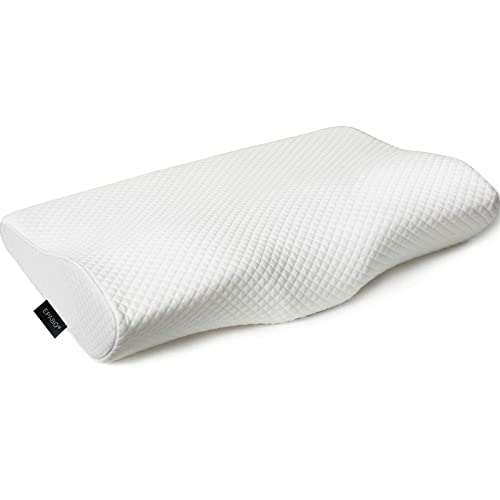
The EPABO takes the classic cervical contour shape and sells it at an accessible level: a raised edge under the neck, a hollow for the head, and shallow cutouts at the sides where your arm can rest. A matching pillowcase is included, a nice touch for an unconventional shape.
Its most useful feature is the dual height. One edge is higher than the other, so rotating the pillow offers about 4.7 or 3.9 inches of loft: wider shoulders start on the taller edge, narrower sleepers on the lower one. The memory foam is firm and slow to respond, and like most solid foam it holds more warmth than latex or fiber.
Specs:
– Fill: memory foam
– Loft: dual height, about 4.7 inches and 3.9 inches
– Size: Queen, about 25 x 15 inches
– Feel: firm
– Extras: pillowcase included, removable cover
Best for: Side sleepers who want to try a contoured shape with two height options in one pillow.
Purple Harmony Pillow, Standard Medium

The Harmony pairs a Talalay latex core with a wrap of Purple’s GelFlex Grid, a stretchy hexagonal lattice that flexes under pressure points and springs back instantly. The feel is buoyant: the latex holds your head up while the grid softens contact at your ear and cheek, the spots that ache on firm foam.
The open grid and latex core let air move through the pillow, and the cover wicks moisture, making this the coolest-running pick in the group. Purple offers three heights; the medium, about 6.5 inches of loft, is where most side sleepers should start. It is heavy, with no fill adjustment, and the springy feel divides people at first touch.
Specs:
– Fill: Talalay latex core with a GelFlex Grid wrap
– Loft: about 6.5 inches (medium height)
– Size: Standard, about 26 x 17 inches
– Feel: medium
– Cover: moisture-wicking, removable
Best for: Hot side sleepers who want responsive, buoyant support and strong airflow through the pillow.
Casper Sleep Original Pillow, Standard

The Casper Original is the traditionalist of the group: a normal-looking pillow with a cleverer inside. It is a pillow within a pillow, with a firmer supportive inner core and a softer outer layer, so your head is cradled without the pillow collapsing flat. The down-alternative microfiber fill gives it the familiar, squeezable feel of a hotel pillow.
For side sleepers, the key detail is the 2-inch gusset, the fabric panel sewn around the edge, which keeps the sides vertical and full so the fill does not squish away where your head rests. It is machine washable, which no foam pick here can claim. The limit is firmness: very broad-shouldered side sleepers may find their head dipping too low, so it shines most for combination sleepers.
Specs:
– Fill: down-alternative polyester microfiber
– Loft: medium, with a 2-inch gusset
– Size: Standard, about 18 x 26 inches
– Feel: medium-soft
– Care: machine washable
Best for: Combination sleepers who move between side and back and prefer a classic pillow shape and feel.
How to choose
Start with loft, because it does most of the work. Picture the gap between the side of your head and the mattress: it is roughly your shoulder width. Broad shoulders need a higher pillow, often 5 to 7 inches once compressed, while narrower frames do well closer to 4 or 5 inches. A soft mattress lets the shoulder sink and shrinks the gap; a firm one leaves the full gap for the pillow to fill.
Next, decide between a fixed contour and an adjustable fill. Contour pillows like the TEMPUR-Ergo and the EPABO hold a fixed shape, with a ridge for the neck and a hollow for the head, and suit sleepers who stay in one position. Adjustable shredded fill, like the Eli & Elm, trades fixed geometry for control, letting you raise or lower the pillow in small steps until your neck feels level.
Look for a gusset on traditional pillows. That sewn panel keeps the sides full, so the loft in the middle is still there at the edge where your head rests. Pinch-edged pillows taper to a seam and lose support where you need it.
Solid memory foam holds heat against the head, while latex, grid designs and fiber fills move more air, so if you run hot, prioritize airflow or a breathable, cooling-feel cover.
Finally, judge firmness by alignment, not by a squeeze in the store: a pillow can feel soft and still let your head drop all night. The head should rest level, neither tilted toward the ceiling nor hanging toward the mattress, with the neck supported along its length.
Who should skip
Stomach sleepers should skip this category and choose a thin, soft pillow instead; loft that helps a side sleeper pushes a stomach sleeper’s neck into an uncomfortable angle. Pure back sleepers with narrow shoulders may also find these contour ridges and taller profiles more than they need.
Skip these pillows as a remedy if you have ongoing neck or shoulder problems, a diagnosed condition, or pain that persists, spreads, or comes with numbness. A better-fitting pillow can improve sleeping position and comfort, but it is not a treatment, and persistent symptoms deserve assessment by a clinician or physical therapist.
Skip the solid foam contour picks, too, if you reshape your pillow several times a night; a molded wave only works when your head stays in it. If you dislike heavy pillows, note that the latex and grid designs weigh noticeably more than fiber.
FAQ
How high should a pillow be for side sleeping?
High enough to keep your head and neck in line with your spine. For most adults that means a loft around 4 to 7 inches, with broader shoulders toward the top of the range. If your head tilts down toward the bed, go higher; if it feels pushed upward, go lower.
Are contour pillows better than regular pillows for side sleepers?
They are better at one job: holding the neck in a supported curve while the head rests in a lower hollow, which suits side sleepers who stay in one position. A regular pillow with a gusset and enough fill can align the neck just as well, and suits people who shift positions or reshape the pillow during the night.
How long does it take to get used to a new pillow?
Give it at least a week unless it is clearly wrong for you. A firmer or higher pillow often feels strange at first while your neck and shoulders adapt. Judge it by how your neck feels across the whole morning, not the first hour, and use any adjustability or dual-height feature before deciding.
When should a side sleeper replace a pillow?
When the fill no longer recovers its loft: a fiber pillow that stays folded in half, foam with a permanent dip, or latex going crumbly at the edges. Fiber pillows tire fastest, memory foam lasts longer, and latex lasts longest. If you start waking with a stiff neck after months of good sleep, lost loft is a likely culprit.
Final verdict
For a dedicated side sleeper, the Eli & Elm is the most purpose-built pick: the shoulder cutout and adjustable fill solve the two problems that make ordinary pillows fail on your side. If you prefer a firm, molded shape, the TEMPUR-Ergo Neck Pillow offers the most structured support, while the EPABO delivers contour geometry with two heights and an included pillowcase. Hot sleepers should look at the Purple Harmony, and combination sleepers who want a normal pillow that behaves on its side will be happiest with the Casper Original. Match loft to your shoulders, and any of these five is a sound start.